
The Story of Sam Darnold
A retelling of Sam Darnold’s eight seasons in the NFL.
Reading Time: 4 minutes
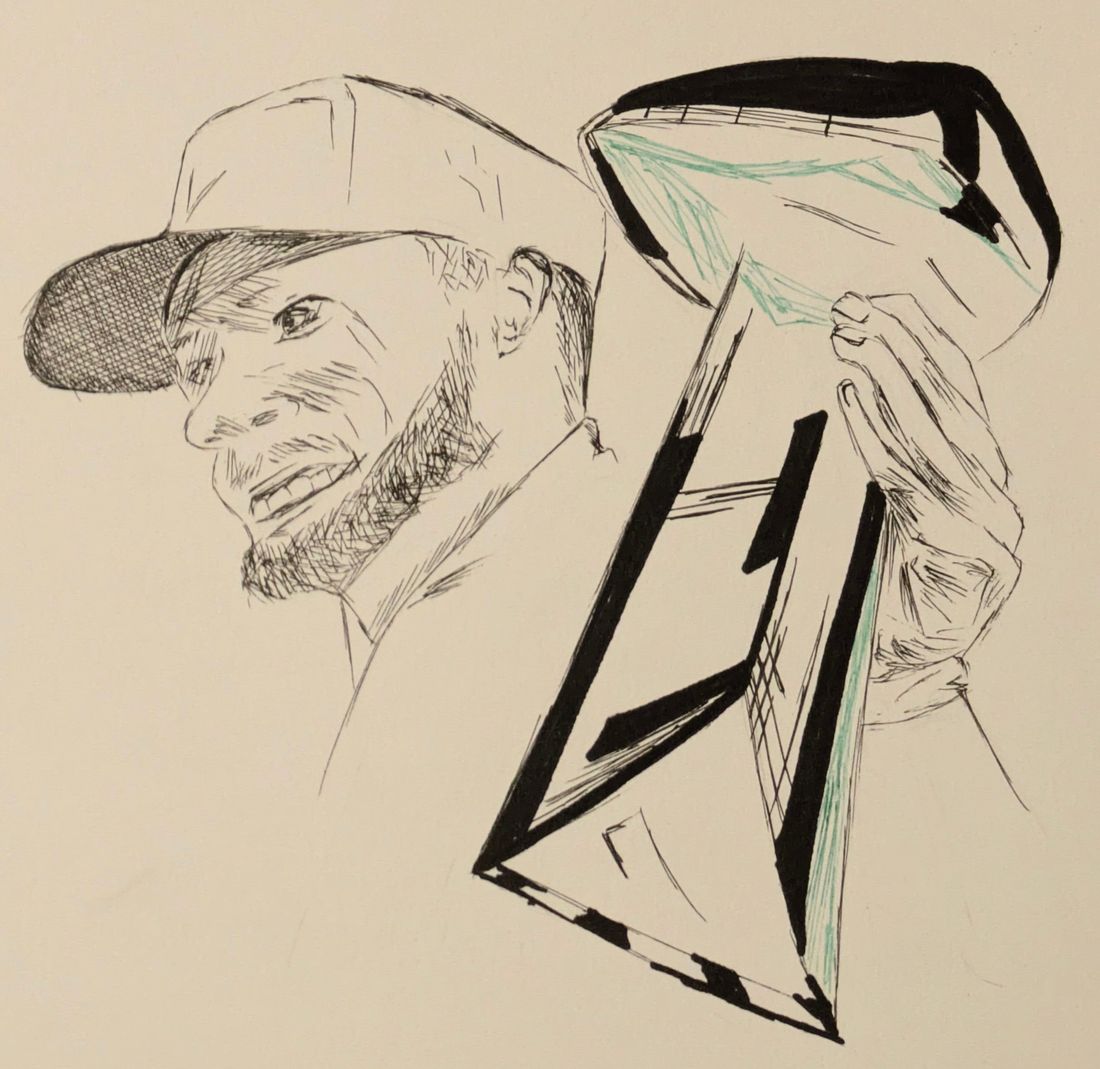
Hoisting the silver Lombardi Trophy with his left hand above his head, Sam Darnold cracked a small smile. After five teams and eight years in the National Football League (NFL), Darnold beat the New England Patriots to win his first Super Bowl. He was instrumental in the success of the Seattle Seahawks’ playoff run, earning a 102.4 passer rating, ranking second among all playoff quarterbacks. He had a regular season to remember, with his second ever Pro Bowl selection. During the season, Seahawks linebacker Ernest Jones IV was asked about Darnold after a poor loss to the Los Angeles Rams. He said, “He’s our quarterback, we got his back, and if you got anything to say, quite frankly, [EXPLETIVE] you.” Yet, it hasn’t always been this way.
As a third overall pick in the 2018 NFL Draft, Sam Darnold had lofty expectations placed on his shoulders. After a productive career in college, having won the Rose Bowl for the University of Southern California, he was expected to replicate his success in the NFL as the New York Jets’ new franchise quarterback.
However, in his rookie year, Darnold fell short of expectations. Encapsulated by his first ever NFL pass—a 37-yard pick-six against the Detroit Lions—Darnold had an extremely disappointing year, throwing for 2865 yards, 17 touchdowns, and 15 interceptions. In fact, in his rookie season, Darnold even had three games rated below a 39.6 passer rating, equivalent to a quarterback intentionally spiking the ball into the ground every single snap. On the season, out of 33 qualified passers with 238 or more pass attempts, Darnold ranked bottom three in passer rating with 77.6. In his second season, in a 33-0 loss to the New England Patriots, Darnold went viral after a clip from the game recorded him saying that he was “seeing ghosts.”
After his third season in New York, in which Darnold had a 2-10 record, and threw more interceptions than touchdowns, the Jets decided to trade him to the Carolina Panthers. In his three seasons with the Jets, Darnold went 13-25, and not only missed the playoffs, but also ranked bottom five in passer rating each season.
Three seasons passed with the Carolina Panthers and one with the San Francisco 49ers, all with no deviation from his sub-par baseline. In 2024, Darnold signed a one-year contract with the Minnesota Vikings to compete for a starting job. In preseason competition, he was set to compete against fellow top-ten draft pick J.J. McCarthy. Because Darnold was considered a veteran presence, the Vikings believed that he could be a serviceable quarterback. However, after McCarthy tore his meniscus in a preseason game, the starting role was handed to Darnold by default.
Even though expectations were low, Darnold delivered in Minnesota. Paired with superstar wide receiver Justin Jefferson and tight end T.J. Hockenson, Darnold led the Vikings to a 14-3 record, throwing for 4319 yards, 35 touchdowns, 12 interceptions, and finishing sixth in passer rating. Even though Darnold played poorly, leading to a disappointing first round exit in the playoffs, many fans and pundits were optimistic about his future with the Vikings. Despite their optimism, the Vikings opted not to re-sign Darnold, intending to start McCarthy at quarterback for the following season.
That offseason, the starting quarterback for the Seattle Seahawks, Geno Smith, chose to sign with the Las Vegas Raiders. The Seahawks, without a quarterback, decided to sign the newly successful Darnold to their team. Paired with breakout superstar wide receiver Jaxon Smith-Njigba, Darnold dominated defenses. Darnold’s pinpoint passes to Smith-Njigba’s blazing fast and razor-sharp routes proved to be an unstoppable combination, helping Smith-Njigba win the Offensive Player Of the Year award and lead the Seahawks to their second ever Super Bowl victory.
Darnold’s feel-good story can’t be dismissed as a one-off, however. The trend of NFL quarterbacks revitalizing their careers after being written off is a tale as old as time. There are both modern and old examples—ones in recent memory include Daniel Jones, Baker Mayfield, and Geno Smith, but also ‘80s era legends like Steve Young and Jim Plunkett.
If for every revitalized career, there are many more busts, it begs the question; for every bust, is it the fault of the NFL franchise whose coaching staff failed to develop young talented quarterbacks and surround them with offensive weapons? Or, as conventionally thought, is it the fault of the quarterback himself?
Given the variable nature of the NFL, evaluating this question is usually most effective on a player by player basis. For Darnold, many claim it was likely an institutional developmental failure. The Jets have had 10 top-ten draft picks in 15 years, but have failed to reach the playoffs every season in that time span. In that same time span, Jets wide receivers have only had 1000-yard seasons just six times, a benchmark of a high quality receiver. After being paired up with top tier receivers on other teams, Sam Darnold developed into a top tier quarterback.
Notably, Darnold himself also credits current San Francisco 49ers starting quarterback Brock Purdy for helping him improve into a Pro Bowl caliber quarterback. The two quarterbacks played together in the 2023/24 NFL season, where Darnold served as Purdy’s backup. In an interview, Darnold said, “I give Brock a ton of credit in showing me the ropes that way. He showed me so much in how to prepare and how to study. He was so helpful that way.”
For many sports fans, Sam Darnold’s career success symbolizes a common sports cliche about the rewards of not giving up. After all, six and a half years after seeing ghosts against the Patriots in a 33-0 loss, he beat the Patriots on the biggest stage of all—the Super Bowl.
Two weeks after Darnold was traded to the Panthers, the Jets drafted BYU quarterback Zach Wilson with the second overall pick of the 2021 NFL Draft. Wilson would last three seasons with the Jets, going a dismal 13-21 as a starter before being traded as part of a package to the Denver Broncos in return for a sixth round pick. After bouncing around the league for the past two years, Wilson finds himself listed as the New Orleans Saints’ third-string quarterback, sitting behind Tyler Shough and Spencer Rattler. Don’t count him off just yet, though. Eventually, he might just turn his career around just like Darnold did.