
The Science That Kills The Giants
The existence of giants is proven false through a physics experiment that Galileo conducted and through the shared failure of the cardiovascular system of human giants.
Reading Time: 4 minutes
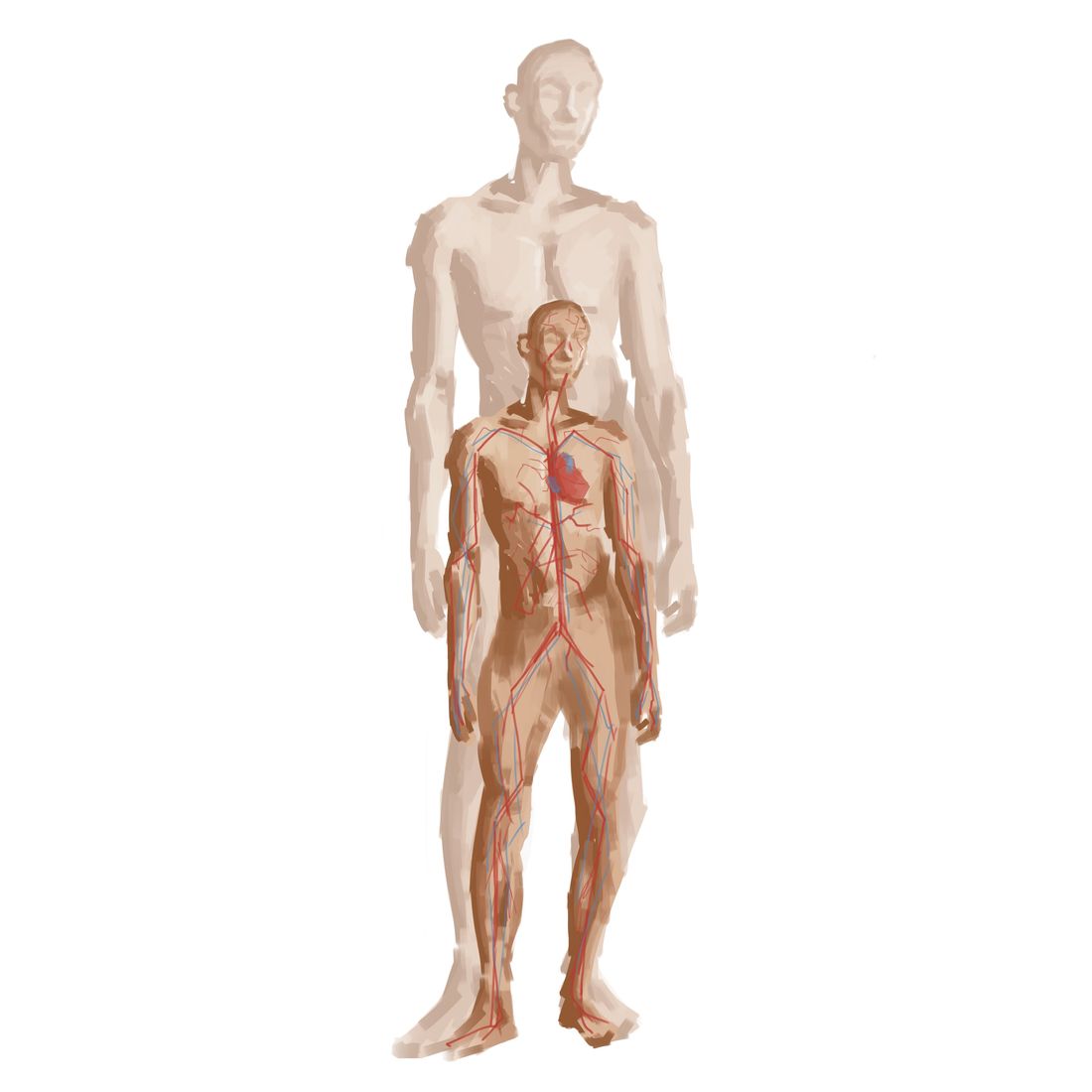
Countless myths and legends portray giants, such as the cyclops, as beings superior to humans. Additionally, some even recount witnessing giants like Bigfoot throughout their lives. For example, in the recent movie adaptation of Homer’s The Odyssey, viewers see Polyphemus, a cyclops, move a massive boulder, trapping Odysseus’s men and eating them. In another scene, viewers see human giants wearing massive armor and wielding swords in a fight to kill Odysseus’s men. Ancient myths describe giants with extraordinary strength moving in human-like ways, but it would be disheartening to discover that the existence of these giants in mythology wouldn't be supported by science. Simple physics and science prove that human giants can’t exist, and even if they did, their bodies wouldn’t be able to function properly like those of normal humans.
One notable argument against the existence of giants is made by Galileo Galilei, a renowned 16th-17th century astronomer, physicist, and engineer. He writes about it in Dialogues Concerning Two New Sciences, published in 1632.
In Dialogues Concerning Two New Sciences, readers are asked to imagine a beam of sturdy oak along with another scaled-up beam, both made with the same material. Imagine that the original beam supports a load of bricks. Although the larger beam will inherently be able to support more weight, Galileo was curious whether the scaled-up beam would be able to support the scaled-up weight of the load. Surprisingly, the answer is no.
The load-bearing strength of a beam is the weight of the heaviest load the beam can support without breaking. The load-bearing strength of the beam depends on the beam’s cross-section, which is the two-dimensional shape that appears when one cuts a beam perpendicular to its length. The failure to support a weight too heavy will result in the breakage of the beam into two different pieces. We can conclude that a beam scaled up 10 times will have a cross-section that's 100 times larger. Since we have established that the cross-section determines the load-bearing strength, we can say that compared to the original beam, a beam that’s 10 times larger is 100 times stronger than the original beam.
Now, we look at the weight of the beam’s load. The weight of the load is influenced by its volume. The scale factor of volume (the factor used to multiply the original volume to obtain the volume of the new load) is the cube of the linear factor (the factor used to multiply the original length to get the length of the new shape). Due to the relationship between the linear and volume scale factors, a load of bricks 10 times larger in length, width, and height would result in a load of bricks 1000 times heavier. A 10 times larger beam is 100 times stronger than the original beam, but the new load for the new beam would be 1000 times heavier than the original. Since the load is 1000 times heavier, even a beam that is 100 times stronger wouldn’t be able to hold it.
With this now in mind, imagine humans whose bodies are scaled up 10 times, functioning like normal human beings. They carry swords and wear plates of armor that are 10 times larger than the originals. But in reality, would this be possible? Probably not. A human 10 times larger would be 100 times stronger than the original human, but their sword would be 1000 times heavier than the original sword. These giant humans wouldn’t be able to wear such large armor and lift such heavy swords, since even a human that’s 100 times stronger than a normal human wouldn’t be able to hold an object that’s 1000 times heavier than the original object.
Other than fantasy giants, real-life human “giants” do exist. Gigantism is a condition in humans that causes too much growth. It is caused by tumors in the brain’s pituitary gland, which produces growth hormones, or enlargement of the pituitary gland. These tumors in the pituitary gland cause it to produce excess amounts of growth hormones, which results in abnormal amounts of heightened growth through stimulating the elongation of bones and tissues. Unfortunately, humans diagnosed with gigantism die at a much earlier age than normal humans. Zeng Jinlian, the tallest woman ever recorded at 8’2’’, passed away at age 17, while Robert Wadlow, the tallest man in history at 8’11’’, died at age 22. Both of these people died due to heart failure, which is the most common cause of death for people diagnosed with gigantism. It occurs primarily because excessive growth hormone and insulin-like growth factor-1 overstimulate the heart muscle, leading to a specific condition called acromegalic cardiomyopathy. In acromegalic cardiomyopathy, the heart is enlarged and has trouble relaxing, increasing the blood pressure and leading to heart failure. Other symptoms of gigantism include enlargement of internal organs, especially the heart; excessive sweating, which is called hyperhidrosis; joint pain; and muscle weakness. If humans who are at most 8’11’’ suffer from these symptoms of gigantism, a much larger giant, such as Polyphemus, would suffer greatly from the failure of his cardiovascular and other bodily systems. In conclusion, even if a giant’s bones were made of different material than human bones, their cardiovascular system wouldn't be able to function properly, making the stories of giants completely impossible to exist in reality.