
China’s Record-Breaking Humanoid Sprinters—and Why They Aren't Ready for Our Homes
While high-speed sprinting shows how fast bipedal robots are advancing, major barriers in safety, battery life, hand dexterity, and cost still keep these machines out of our homes.
Reading Time: 3 minutes
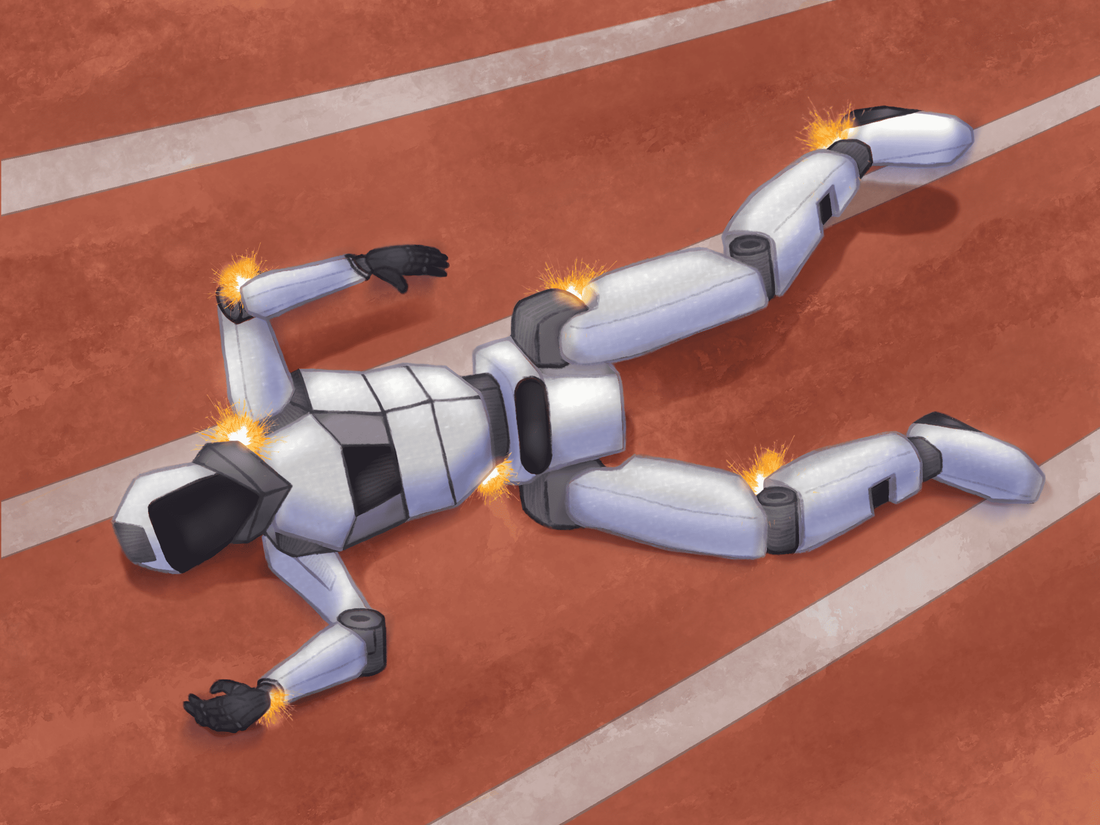
When X-Humanoid’s Tiangong Ultra ran the 100-meter sprint in 8.64 seconds at the 2026 World Humanoid Robot Games, it shattered previous bipedal benchmarks. Still, after crossing the finish line, the robot crashed into a padded wall and caught a small fire in its torso, while other competing humanoids collapsed mid-race, their mechanical limbs sprawled across the track. Beyond the spectacle of runaway machines and dramatic collisions, these showcases serve as high-stress testing grounds and global marketing platforms, showing the world how rapidly bipedal robots are progressing toward residential deployment. These public trials push robots beyond laboratory conditions to show their limits.
For humans, standing upright and running feels second nature because our bodies unconsciously detect changes in balance and coordinate muscle micro-adjustments to remain stable. However, robots have to compute these changes in real time, and the smallest error in timing could cause a fall.
Because a robot's heavy torso sits above its small foot contact area, it acts as an inverted pendulum—a mechanical system with its center of mass positioned above its pivot point—where the top constantly wants to tip over unless the base moves to catch it. Engineers cannot simply shift heavy components lower into the legs, because adding weight to moving limbs makes leg movement sluggish, forces the robot’s motors to work much harder, and drains the battery more quickly during basic movement.
To keep top-heavy humanoids stable, the Zero Moment Point is constantly calculated. The Zero Moment Point is the specific location on the ground where all acceleration and gravitational forces balance out, meaning that as long as this point stays inside the footprint area, the robot will remain dynamically stable.
Although it may seem impractical or unnecessary to build bipedal robots, engineers often prioritize two-legged humanoid designs for residential purposes because human living spaces are built specifically for human geometry. Even though wheeled or quadrupedal robots offer superior stability on flat terrain, they can struggle with climbing stairs or moving through cluttered floors. Bipedal designs are uniquely suited to navigate typical human environments without extensive architectural modifications.
The capabilities of humanoid robots on the track are undeniable, but there still remain severe barriers that prevent these machines from entering our homes. It is important to note that robots built for speed are not the same as those being developed for domestic duties. Track sprinters are specialized and stripped down to maximize leg power, whereas household models require heavier, more complex upper bodies equipped with more dexterous arms to handle everyday objects.
One of the most critical issues involves safety. While a falling metal body on a track only damages itself, a fall in a home creates severe safety risks to people, pets, and property. Current balance algorithms cannot completely guarantee no falls—as viewers of the humanoid games witnessed—especially when robots encounter the unexpected obstacles of unique home environments. Constant micro-adjustments and high-frequency computations also demand substantial energy, rapidly draining batteries. These battery packs can run extremely hot, creating a fire risk.
Besides these risks, robots remain limited in ability: their fine motor control lags behind their athletic mobility. End effectors struggle to create effective grip and dexterity due to inadequate contact surface and force feedback, making everyday tasks such as handling delicate items or folding clothes difficult. Without sensitive feedback, a robotic hand strong enough to lift a tray might crush a glass.
High manufacturing costs also make them too expensive for many households to buy.
A single humanoid robot requires dozens of high-precision components—including specialized electric rotary and linear actuators, frameless torque motors, planetary roller screws, harmonic reducers, dexterous hands, and complex AI processor chips—all of which are costly. However, overall hardware costs are projected to decline significantly between 2030 and 2035 due to economies of scale and advances in component design.
High-speed running might make for an impressive headline, but raw speed on a track only tests humanoids on a narrow aspect of what they need to become effective in homes. Other events at the humanoid games, such as soccer or weightlifting, actually provide a much better signal of domestic readiness as they require robots to react to unpredictable movements or maintain dynamic balance under weight. However, in these more complex events, robots frequently stumbled during simple turns, misread ball trajectories, or failed to grip uneven weights.
Until engineers can solve fall risks, thermal fire hazards, limited hand dexterity, and steep manufacturing costs together, these machines will remain restricted to controlled tracks rather than entering our homes.